
Introduction
Most organisations don’t struggle because they lack strategy.
They struggle because they cannot describe how work actually happens.
Ask five teams in the same organisation to explain a process end-to-end and you’ll usually get five different versions. None of them are necessarily wrong. They are just incomplete in different ways.
That gap is where transformation programmes quietly fail.
BPMN 2.0 (Business Process Model and Notation) exists to solve exactly this problem. Not as an academic modelling language, but as a practical standard for describing how work flows through an organisation in a way that business, operations and technology can all execute against.
Defined by the Object Management Group, BPMN 2.0 has become the de facto standard for process modelling in enterprise transformation programmes.
Yet in practice, most organisations either overcomplicate it or underuse it.
Used correctly, BPMN 2.0 becomes a foundation for building a Target Operating Model, designing workflows, and delivering transformation that actually sticks.
Used poorly, it becomes another set of diagrams nobody reads.
This guide explains BPMN 2.0 in simple, practical terms based on real transformation delivery experience across telecoms, insurance, financial services, legal, recruitment, construction, payroll, and HR operations.
What Is BPMN 2.0?
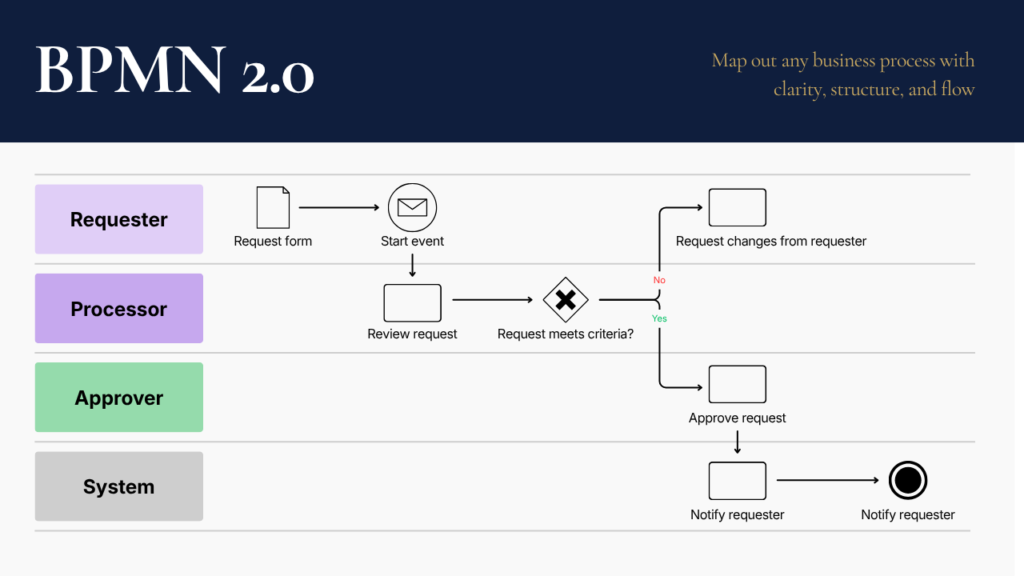
BPMN 2.0 is a standard visual language used to model business processes in a structured and consistent way.
In simple terms:
BPMN 2.0 shows how work moves from start to finish, including decisions, tasks, systems, and exceptions.
It is not just a diagramming tool.
It is a modelling standard designed to:
- Remove ambiguity in process design
- Standardise how processes are described
- Enable automation and workflow execution
- Bridge business and IT understanding
- Support operational and system implementation
Where traditional flowcharts describe intent, BPMN describes behaviour.
That distinction is critical in any Target Operating Model design.
Why BPMN 2.0 Matters in Enterprise Transformation
Most transformation programmes fail at execution, not design.
The strategy is usually clear. The breakdown happens when teams interpret processes differently.
BPMN 2.0 solves this by introducing a shared language for process behaviour.
1. It creates a single version of operational truth
Without BPMN, process definitions are often scattered across:
- Word documents
- PowerPoint slides
- Spreadsheets
- Tribal knowledge
BPMN replaces that with a structured model everyone can follow.
2. It exposes inefficiencies that are otherwise hidden
Once you map a process properly, you quickly see:
- Bottlenecks
- Duplicate approvals
- Manual interventions
- Unnecessary handoffs
- System gaps
These issues rarely appear in high-level operating model discussions.
3. It connects business design to system delivery
BPMN is widely used as a bridge between:
- Business analysis
- Process redesign
- Workflow automation
- System configuration
This is why it is central to digital transformation and Target Operating Model implementation.
The Core Elements of BPMN 2.0 (Explained Simply)
BPMN looks complex at first glance, but it is built on four simple building blocks.
1. Events – What triggers or ends a process
Events represent something that happens.
Examples:
- A customer submits an application
- A payment is received
- A deadline is reached
- A system sends a signal
Events define the start, interruption, or completion of work.
2. Activities – What work is performed
Activities are the tasks carried out by people or systems.
Examples:
- Verify customer identity
- Assess risk
- Approve request
- Update system record
These represent actual operational work.
3. Gateways – Where decisions are made
Gateways control branching logic.
Examples:
- Approved vs rejected
- Complete vs incomplete data
- High risk vs low risk
Gateways are where business rules live. Poorly defined gateways are one of the most common causes of inconsistent operations.
4. Flows – How work moves
Flows define how everything connects.
They show:
- Sequence of tasks
- Parallel work
- Handoffs between teams
- System-to-system interactions
Without flows, processes become fragmented and unclear.
BPMN 2.0 vs Traditional Process Mapping
Many organisations already use process maps.
The issue is that most are not precise enough for transformation.
| Traditional Process Maps | BPMN 2.0 |
|---|---|
| High-level steps | Detailed operational logic |
| Ambiguous decisions | Explicit rule-based gateways |
| Weak system linkage | Supports automation and systems |
| Inconsistent formats | Standardised notation |
| Difficult to scale | Enterprise-grade modelling |
For a Target Operating Model, precision matters. Ambiguity leads to failed implementation.
How BPMN 2.0 Supports a Target Operating Model
BPMN is not just a modelling tool. It is a design foundation for operating model delivery.
1. As-Is Process Understanding
BPMN is used to map current operations.
This typically reveals:
- Workarounds created by teams
- Manual data entry points
- System limitations
- Hidden approval layers
- Policy deviations
This is often the first moment leaders see how work actually flows.
2. To-Be Process Design
Once the current state is understood, BPMN is used to design future operations.
This includes:
- Standardised workflows
- Automation opportunities
- Reduced handoffs
- Clear ownership
- Embedded controls
This becomes the operational blueprint of the Target Operating Model.
3. Gap Analysis
BPMN makes it easy to compare:
- What steps are removed
- What is automated
- What roles change
- What systems are required
This directly feeds transformation roadmaps.
4. Implementation Readiness
Well-built BPMN models can be used for:
- Workflow engine configuration
- System development
- Test case creation
- Operational training
- RPA design
This is where BPMN moves from design to execution.
Practical Example: BPMN in Customer Onboarding
A financial services organisation is experiencing slow onboarding cycles (8–12 days).
As-Is Findings Using BPMN
The process reveals:
- Multiple data entry points
- Manual KYC verification
- Repeated compliance checks
- Email-based approvals
- No single system of record
The problem is not one step—it is structural fragmentation.
To-Be BPMN Redesign
The redesigned process includes:
- Single digital intake (event trigger)
- Automated identity verification (activity)
- Rule-based risk scoring (gateway)
- Parallel compliance checks (flows)
- Automated approval routing
Outcome
- Onboarding reduced to 2–3 days
- Significant reduction in manual effort
- Improved compliance traceability
- Clear accountability per step
This is exactly how BPMN supports a real Target Operating Model—not theoretically, but operationally.
Common Mistakes When Using BPMN 2.0
Even experienced teams misuse BPMN.
1. Treating it as documentation only
BPMN is often used to “draw what we already do.”
That misses the point entirely.
Its value is in design and change.
2. Overcomplicating diagrams
Some models become so detailed they cannot be used.
Good BPMN should be:
- Readable
- Structured
- Operationally meaningful
Not an academic diagram.
3. Weak decision logic
Gateways without clear rules lead to inconsistent execution.
Every decision point must be defined.
4. No link to systems or automation
If BPMN is not connected to delivery platforms, it stays theoretical.
It must support:
- Workflow tools
- ERP systems
- CRM platforms
- Automation engines
5. Excluding operational input
Processes designed without frontline validation fail in reality.
BPMN must reflect how work is actually executed.
Key Related Concepts
To fully understand BPMN 2.0 in a transformation context, it connects strongly with:
- Business process modelling
- Process architecture
- Workflow automation
- Business analysis
- Enterprise architecture
- Digital transformation strategy
- As-is / to-be analysis
- Process optimisation
- Operational governance
- Continuous improvement frameworks
These concepts all feed into effective Target Operating Model design.
What Good BPMN Looks Like in Practice
High-performing organisations use BPMN as:
A design tool
To define future-state operations.
A communication tool
To align business, operations, and IT.
A delivery tool
To support system configuration and automation.
A governance tool
To standardise process ownership.
When all four are present, BPMN becomes part of how the organisation operates—not just how it documents work.
Key Takeaways
- BPMN 2.0 is a standard for modelling real business processes clearly and consistently
- It is essential for building an implementable Target Operating Model
- It removes ambiguity between business, operations, and technology teams
- It supports both current-state analysis and future-state design
- It enables automation, system design, and operational improvement
- Poor usage leads to complexity; good usage drives execution
- The real value is not documentation—it is implementation
Conclusion
BPMN 2.0 is often misunderstood as a technical modelling standard.
In practice, it is one of the most practical tools available for delivering successful enterprise transformation.
When used correctly, it ensures that operating model design is not just conceptual—it becomes executable.
Across telecoms, insurance, financial services, legal, recruitment, construction, payroll and HR environments, one pattern is consistent:
Organisations that invest in clear process modelling deliver more successful transformation outcomes.
Not because they design better diagrams.
But because they design operations that can actually be implemented.
That is the real role of BPMN 2.0 in a Target Operating Model: turning intent into operational reality.
And in transformation delivery, that is the only thing that ultimately matters.
FAQ – BPMN 2.0 Explained Simply
What is BPMN 2.0 used for?
BPMN 2.0 is used to model business processes in a structured way so organisations can understand, analyse, and improve how work flows end-to-end.
Is BPMN 2.0 difficult to learn?
The basics are simple. Complexity only increases when modelling enterprise-scale processes with multiple systems and decision paths.
How does BPMN 2.0 support a Target Operating Model?
It defines how processes will operate in the future state, making the operating model actionable and implementable.
What is the difference between BPMN and flowcharts?
Flowcharts are simple diagrams. BPMN is a structured industry standard that supports automation, system integration, and complex process logic.
Why is BPMN important in digital transformation?
Because it translates business requirements into executable process models that can be implemented in systems and workflows.